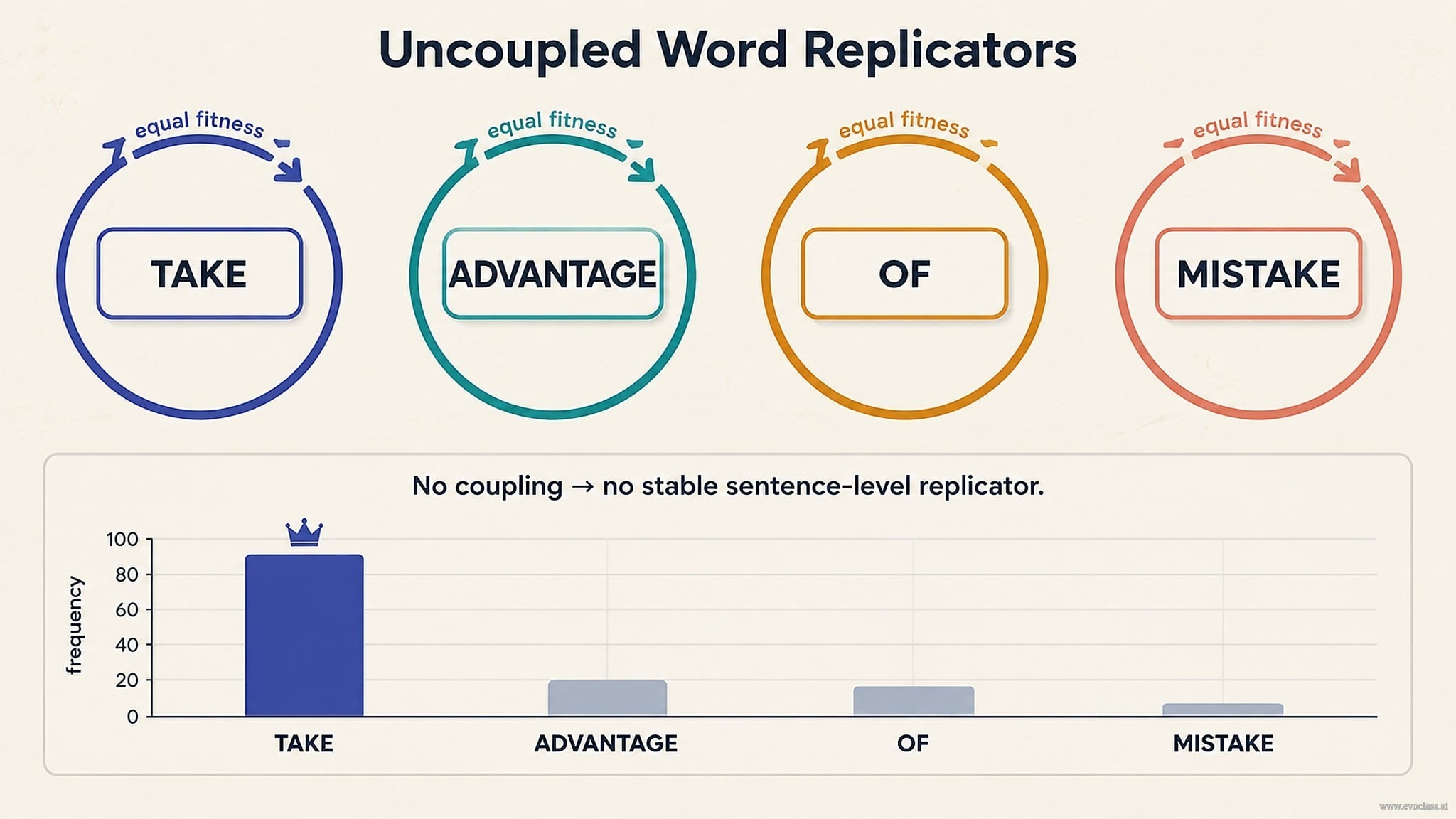
In the sentence game, the string TAKE ADVANTAGE OF MISTAKE is not treated as one reproducing entity. It is decomposed into four independent word-replicators: TAKE, ADVANTAGE, OF, and MISTAKE. Each word has its own replication loop, and in the basic game all four are assigned the same replication rate. They are therefore selectively equivalent: no word has a selective advantage over any other, and no word cooperates with or depends on any other.
Selective advantage in molecular terms
For a molecule or a word-replicator, selective advantage means a heritable difference in replication rate under the same organization constraints. It is not thermodynamic stability, not semantic meaning, and not physical size. In the sentence game, equal replication-rate constants mean zero selective advantage among TAKE, ADVANTAGE, OF, and MISTAKE.
Why equal fitness is not enough for a stable sentence
Under constant organization, the normalized concentration of word i can be written as dx_i/dt =
Example: TAKE fixes by drift
If TAKE happens to increase in frequency, nothing in the uncoupled game ties its replication to ADVANTAGE, OF, or MISTAKE. The sentence can break down into an uncoordinated mixture of independently evolving words. Only coupling—where replication of one component depends on others—could preserve the sentence as a unit.
What would make the sentence a replicative unit?
The sentence would become a higher-level unit only if its words were coupled—if replication of one word depended on the presence of another. A linear coupling chain feeds advantage forward and tends to concentrate growth in the last member. Closing that chain into a loop creates a hypercycle of second degree: the four words then hold stable, periodically varying population numbers, and the sentence-level organization is preserved rather than dissolving into independent word lineages.
Uncoupled Word Replicators
Four equally fit word replicators, TAKE, ADVANTAGE, OF, and MISTAKE, each have their own replication loop. Without coupling, one word lineage can fix by drift or competition while the sentence itself is not preserved.